Myrtle Beach Senior Advisor
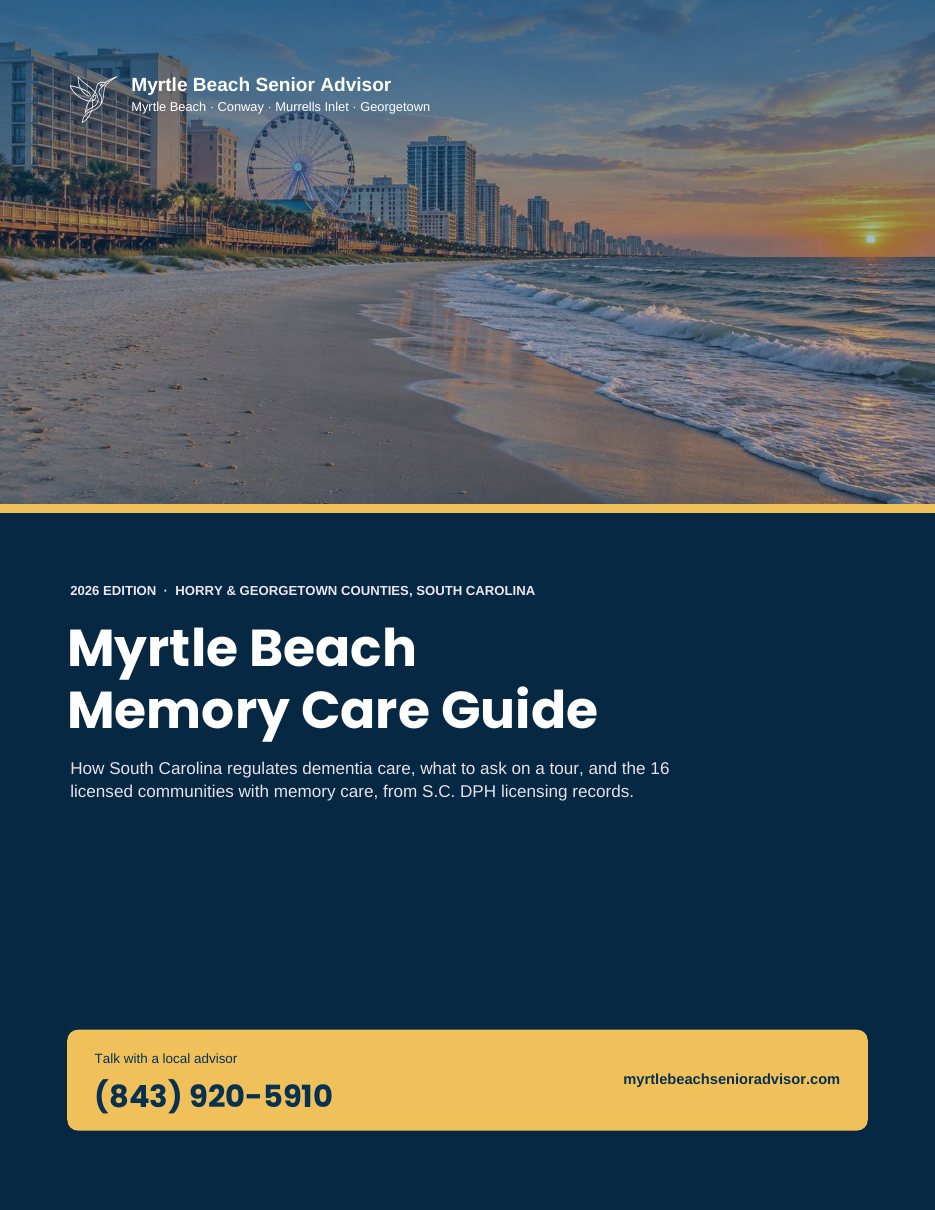
6-page PDF. DPH data pulled November 14, 2026.
What is in the Myrtle Beach Memory Care Guide?
What the PDF covers:
- When assisted living is enough and when a secured setting is safer.
- What South Carolina requires of a community that serves residents with dementia, with the rule citations.
- 16 licensed communities in Horry and Georgetown counties identified as offering memory care, with 1,411 licensed beds.
- What memory care costs relative to the statewide assisted living median.
- A touring checklist built for dementia care, including what to watch for at the end of the day.
How is memory care different from assisted living in South Carolina?
Memory care in Horry and Georgetown counties is a specialized form of assisted living for people with Alzheimer's disease or another dementia, with secured exits and staff trained for it.
| Assisted living | Memory care | |
|---|---|---|
| Need | Daily help, mostly independent | Memory loss that makes living alone unsafe |
| Environment | Apartment-style, unrestricted | A secured wing or small house |
| Day | Self-directed | Planned activities with cueing |
| Bill | Base plus care level | Typically the higher of the two |
How does South Carolina regulate memory care?
Around Myrtle Beach, memory care means a secured Alzheimer's special care unit inside a licensed CRCF or nursing home. South Carolina issues no memory care license; instead the Alzheimer's Special Care Disclosure Act makes each program describe its dementia care in writing, and DPH's data records which buildings run a unit.
- Definition. Regulation 60-84 treats a unit as a secured area or program promoted as dementia care.
- Disclosure. Programs must state in writing what is special about their care and what it costs.
- Staffing. No unit-specific ratio: the building-wide 1-to-8 peak and 1-to-30 off-peak minimum applies.
- Moving out. Unmanageable behavior or a need for daily nursing triggers a transfer within 30 days.
How many Horry and Georgetown counties communities offer memory care?
Horry and Georgetown CRCFs that DPH's licensing data flags for an Alzheimer's special care unit, 16 licensed communities in Horry and Georgetown counties offer memory care, with 1,411 licensed beds between them.
They are concentrated in Myrtle Beach (8), Murrells Inlet (4), Little River (2) and Pawleys Island (2). 0 of them are small settings licensed for 10 beds or fewer.
What does memory care cost in South Carolina?
No memory care median is published for the Grand Strand or South Carolina. Programs here usually price it as the assisted living rate plus a dementia care charge, so ask for one written monthly total.
How do I judge a memory care community in Myrtle Beach on a tour?
Visit late in the afternoon if you can, when residents are often most restless, and ask:
- What dementia training do caregivers receive, and how often is it refreshed?
- What would make you ask a resident to move out?
- Who decides when a resident moves from assisted living to the secured unit?
- How do you handle a resident who becomes distressed in the evening?
- What happens if a resident wanders out?
Who speaks up for a memory care resident on the Grand Strand?
The regional Long Term Care Ombudsman Program, based at the Waccamaw Area Agency on Aging (843-546-8502), visits assisted living and nursing homes in both counties and helps residents and families with problems about care, rights or a discharge notice. Under the Omnibus Adult Protection Act it also takes reports of suspected abuse of facility residents, while DPH Healthcare Quality handles licensing complaints at 1-800-922-6735.
Want a shortlist instead of a long read?
Of the 16 communities with memory care, only some will have a bed this month. We can find out which.
(843) 920-5910More free downloads
Who publishes this guide, and how is it paid for?
The guide comes from Myrtle Beach Senior Advisor, a referral service for Horry and Georgetown counties. Families are never charged; a provider pays a fee only after a family we introduced chooses it.
Nobody bought a spot in the guide. Its lists are drawn from the S.C. Department of Public Health (DPH), Healthcare Quality record, and it is general information rather than medical, legal or financial advice.